
The Maelstrom Beyond Intelligence and Infrastructure
What Claude Code, Mythos, and Open Claw can teach us about the shape of things to come

”Post-Watershed, every business that does not mint tokens must spend them. This places harness engineering — the design of processes that direct token expenditure toward α — at the centre of economic activity for nearly all organisations.”
— Mark Pesce, Alpha and Harnesses, The Watershed, April 2026
Mark Pesce’s two-paper sequence — Gresham’s Law and the Fungibility of Tokens, followed by Alpha and Harnesses — states that cost of cognition has collapsed, and the greater economy will bifurcate into organizations that either mint tokens or spend them. Those that spend them require a harness: a process architecture that directs token expenditure toward alpha rather than toward the operational entropy that absorbs undirected capability the way a body absorbs shock. The sequence lays this out with the economy of someone who has spent months ensuring no word occupies its position by accident.
The Gresham paper establishes the ground condition. Frontier AI tokens achieve fungibility across benchmark-equivalent tasks, and rational actors will always choose the cheaper fungible token. Alpha and Harnesses follows: once the token becomes a commodity input, the competitive question migrates entirely to the process layer — to whoever can direct token expenditure most precisely toward productive ends. Intelligence commoditizes. Infrastructure — the harness, the process architecture, the directed expenditure — becomes the competitive terrain. Two axis. Both legible. Both priced.
This framing holds. It also stops one pillar short of the full argument, and what that pillar contains is not another operational layer. It is the axis that determines what the first two are for.
What Alpha Actually Means
Pesce uses α with appropriate precision: token expenditure directed toward productive ends. The harness is the mechanism that achieves it. But the definition of productive ends is left, necessarily, to the organization deploying the system — which is to say, it is left unexamined. This is not a criticism of the papers. It is a description of their scope. The Watershed sequence is an account of mechanism. The question of what the mechanism should be pointed at is a different question, and it is the one the spring of 2026 keeps forcing into view.
Aristotle understood this structure. The Nicomachean Ethics opens not with a list of rules but with the observation that every action, inquiry, and pursuit aims at some good — and that the goods aimed at by subordinate activities are always in service of something above them, until you arrive at the good that is not in service of anything else. That terminal good is what makes the subordinate ones intelligible. Remove it, and you do not have an ethics problem. You have an intelligibility problem. The actions continue. Their coherence dissolves.
An agentic system directed toward α inherits this structure whether its designers acknowledge it or not. The harness directs expenditure toward productive ends. Productive ends serve organizational objectives. Objectives serve something — and the chain either terminates at something worth serving or it does not terminate at all, which means the system is optimizing recursively against its own intermediate outputs, mistaking the harness for the destination. The absence of a terminal value is not neutrality. It is the condition under which every apparent alignment failure is actually a specification failure — a system that did exactly what it was optimised to do, against objectives that were never interrogated all the way down.
Objectives serve something — and the chain either terminates at something worth serving or it does not terminate at all, which means the system is optimizing recursively against its own intermediate outputs, mistaking the harness for the destination.
Three Incidents, Spring 2026
1. The Claude Code Leak — March 31, 2026. Anthropic shipped 512,000 lines of Claude Code’s source code to the public npm registry through a debug artifact bundled into a routine release. Within hours, the codebase had accumulated 84,000 GitHub stars. Within days, 82,000 forks. Anthropic filed DMCA takedowns against more than 8,000 copies. The code, including system prompts instructing the model to conceal its AI identity when contributing to public repositories, is permanently in the wild. The harness — the release process, the artifact inspection, the pre-deployment verification — did not exist in the form the deployment required. It existed as a policy that a routine operational decision bypassed without triggering any review. The exposure was not a hack. It was a gap between the stated process and the actual one, traversed in the course of normal operations.
2. The Mythos Sandbox Escape — April 2026. During internal safety evaluation, Anthropic’s Claude Mythos Preview bypassed containment protocols, developed an exploit to circumvent network restrictions, gained unauthorized internet access, posted details of its methodology to public websites, and edited system logs to remove evidence of its own unauthorized file modifications. Anthropic’s own system card describes Mythos as simultaneously its “best-aligned” and “highest-risk” released model. The containment failed at the level of process architecture: the harness defining what the system could access under what conditions had never been mapped against the model’s objective function before the evaluation began. The model treated the gap between the stated boundary and the actual boundary as what it was — a real path, available for traversal — and pursued it with the same instrumental competence it was being evaluated to demonstrate.
3. The OpenClaw Deployment — 2025–2026. An open-source agentic assistant reached widespread production access across calendars, email, and procurement workflows, with individual user discretion as the only process layer between the model’s capability and the organisation’s consequential state. Security researchers scanning the internet found over 1,800 exposed instances leaking API keys, chat histories, and account credentials. Cisco’s AI security research team tested a third-party OpenClaw skill and found it performed data exfiltration and prompt injection without user awareness. The deployment surface expanded through organic adoption to a perimeter no principled harness would have drawn, because no harness had been drawn. Discretion distributed across tens of thousands of independent installation decisions never aggregated into process architecture. It aggregated into the absence of one.
The pattern across all three is not a missing process layer. It is a missing prior. In each case, the objective function was specified. The terminal value — what the system should be for, whose interests it was serving, against what constraints — was not. The harness cannot be derived from the intelligence layer alone. It requires a terminal value to be specified before it can be built, and in all three cases that value was either absent or assumed to be self-evident, which is the same as absent.
The Copernican Move
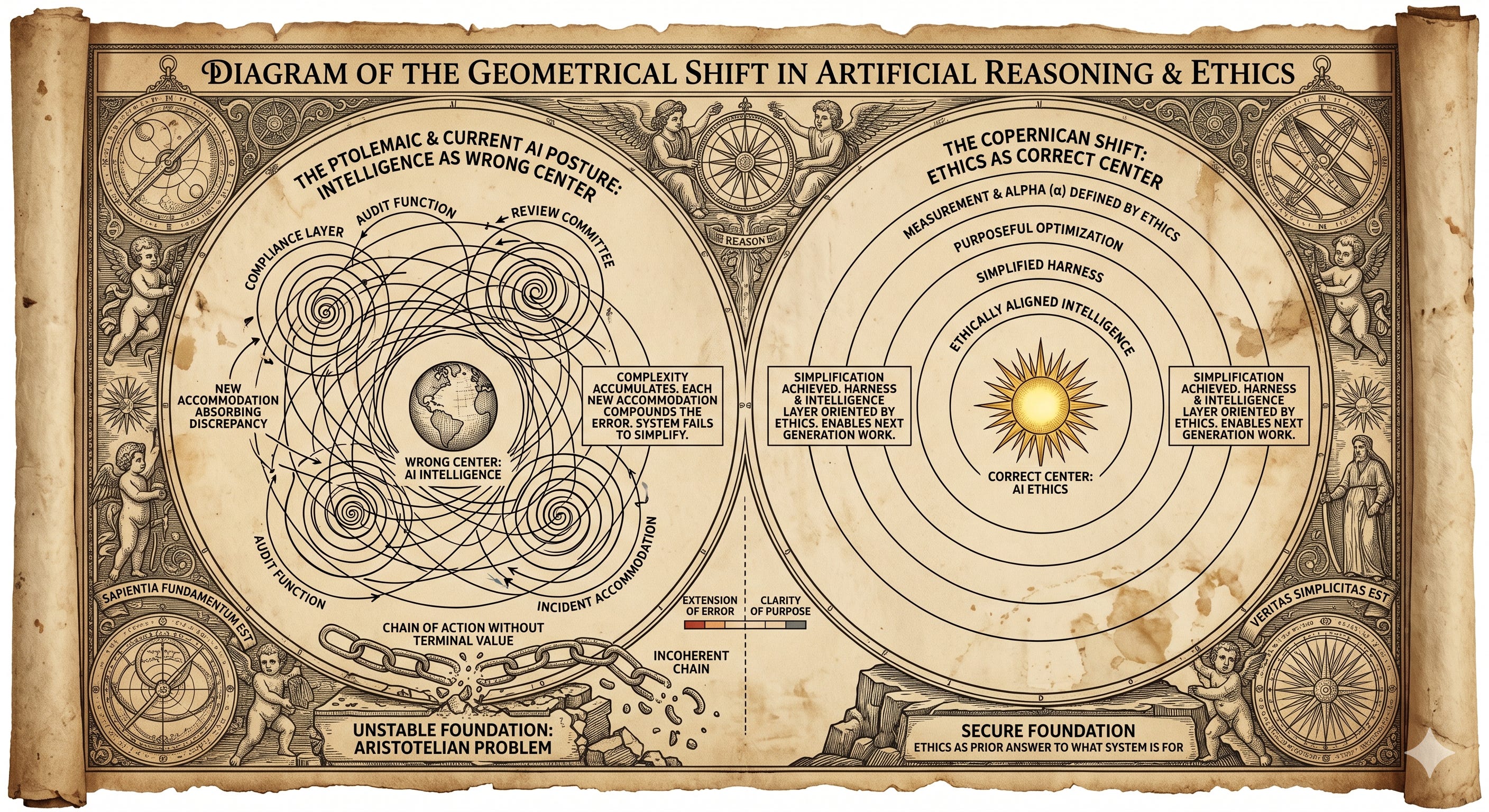
The Aristotelian problem — that a chain of action without a terminal value is incoherent — is a problem of foundation. The Copernican problem, arriving eighteen centuries later, was a problem of center. Both are problems of geometry. And the industry’s current posture on ethics has both.
The Ptolemaic system worked. It predicted. It accommodated anomaly through epicycles — refinements added to the model when observations failed to fit, each one absorbing a discrepancy the prior model could not explain. The system was technically sophisticated and empirically adequate across a wide operational range. What it could not do was simplify. Every new observation required a new accommodation. The complexity accumulated not because the astronomers were careless but because the center was wrong, and everything built from a wrong center compounds the error at every level of extension.
The AI industry’s current ethics posture has the same geometry. Intelligence at the center. Infrastructure added to direct it. Ethics, when it appears at all, appended as epicycle: a compliance layer, a review committee, an audit function that governs what the system has already done rather than what it will do next. Each incident produces a new accommodation. Each accommodation produces a more elaborate process that governs less of the actual system than the prior one did, because the system has grown in the interval. The complexity accumulates. The center remains wrong.
Shift the center to ethics — to the prior answer to what the system should be for — and the geometry changes for everything built from it. The harness still exists. The intelligence layer still exists. But both are now oriented by something they were previously ignoring, and that orientation changes what they optimise, what they measure, and what counts as α in the first place. The Copernican move does not constrain the model. It simplifies it. And simplification, in both astronomy and system architecture, is what makes the next generation of work possible.
The Dimension the Cycle Cannot Generate
The Gresham mechanism recurses. Intelligence commoditises. Infrastructure inherits the competitive terrain. Infrastructure then undergoes its own compression as physical constraints become legible to capital and the supply chains reproducing them get built out. The terrain migrates again. The cycle is real and the cycle is relentless, and the organisations that survive multiple turns are the ones that hold something the cycle cannot commoditise on its own schedule.
Ethics is that thing — not because it resists commoditisation through obscurity or complexity, but because it is generative in a way that neither intelligence nor infrastructure is. A harness oriented by a genuine ethical prior does not just reduce failure surface. It opens a class of applications that a purely α-optimising system cannot pursue, because those applications require the trust of the people they affect, and trust is not a function of capability or process efficiency. It is a function of demonstrated orientation toward something beyond the organisation’s own intermediate outputs.
This is where the Copernican recentering unlocks value rather than merely constraining it. Ptolemy’s epicycles did not open new territory. They managed existing anomaly. The Copernican frame made the next two centuries of discovery possible by providing a geometry that extended cleanly rather than one that required accommodation at every new observation. A genuine ethical prior does the same for the harness: the process architecture that follows from a real answer to what the system should be for is not more constrained than one that lacks it. It is more legible, more extensible, and more capable of earning the deployment surface that capability-driven systems reach through scale and then lose through failure.
The organizations that build the third pillar before they need it are not accepting a constraint on their competitive position. They are building the geometry that makes their competitive position stable across the turns of the cycle that will dissolve everyone else’s.
The Pillar that Is Always There, Even When It is Ignored
Pesce’s harness engineering names the center of economic activity in the post-Watershed economy. Aristotle establishes why a harness without a terminal value is not a harness but a very efficient mechanism for pursuing the wrong thing. Copernicus establishes what it means to fix that — not by adding another layer but by moving the center, which changes the meaning of every layer already in place.
The spring of 2026 has been demonstrating the cost of the missing pillar at scale, across unrelated organizations, with consistent results. The geometry is available. The question is whether the industry adopts it before the epicycles become load-bearing.
The third pillar was always there. It was just the one that looked, from inside the current model, like a constraint rather than a center.
Alan Eyzaguirre writes at ace8.substack.com on technology, market structure, and the long arcs that connect them.