
The Copernican Operator: What a Single Math Function Tells Us About the Future of Intelligence
On discovery, reduction, and the peculiar bravery it takes to believe the universe might be simpler than we made it.


All Elementary Functions from a Single Binary Operator
There is a particular species of scientific result that does not announce itself as revolutionary. It arrives wearing the modest clothes of a preprint — no press release, no keynote, no breathless TED talk. And yet it contains within it something structurally detonating: the suggestion that an entire edifice of complexity we built over centuries was not complexity at all, but accumulation. The piling up of epicycles around a truth that was, all along, considerably more parsimonious.
Andrzej Odrzywołek, a physicist at the Jagiellonian University in Kraków — the same institution where Nicolaus Copernicus studied from 1491 to 1496 — published a paper in March 2026 that belongs to this species. Its title is almost aggressively understated: *All elementary functions from a single binary operator*. The claim is exactly as stated. Every elementary function in mathematics — exponential, logarithm, trigonometric, hyperbolic, roots, polynomial arithmetic, transcendental constants — can be expressed as a combination of a single two-input operation. The operator is:
eml(x, y) = exp(x) − ln(y)
That is the entirety of it. Two buttons. One constant, the number 1. And from these three things, if you are patient enough to compose them in the right tree, you can reconstruct every function that mathematics has produced since Euler.
What Copernicus Actually Did
Before we can appreciate what this means, we need to sit with what Copernicus actually accomplished — and what he did not.
The standard story goes: Ptolemy said the Earth was the center, Copernicus said the Sun was the center, and everyone had to adjust. This is true but misleading. The deeper story is about the structure of explanation itself. The Ptolemaic system, which had governed astronomical prediction for roughly 1,400 years, was not wrong in the way that “the Earth is flat” is wrong. It was, in fact, predictively adequate. Ptolemy’s Almagest gave you accurate planetary positions. The system worked. The problem was what it cost to make it work.
The cost was epicycles — auxiliary circles orbited upon orbits, nested corrections upon corrections, each one added to account for a discrepancy the underlying model could not otherwise explain. Estimates put the total circle count in the Ptolemaic system at 80, compared to roughly 34 in the Copernican model. More significant than the count was the kind of complexity. Ptolemy’s model required a different mechanism for each planet, each with its own special-case treatment. Copernicus, by relocating the origin of the coordinate system from Earth to the Sun, revealed that retrograde motion — the puzzling apparent backward drift of outer planets — was not a property of the planets at all. It was a consequence of perspective. The Earth, also moving, simply outpaces the outer planets at certain points in its orbit. The phenomenon that demanded an epicycle in one framework required no mechanism at all in the other.
This is the Copernican move: not the addition of knowledge, but the subtraction of assumed complexity by finding the right center.
Copernicus was a student at the Jagiellonian University when that institution was already a center of observational astronomy — instruments in the Collegium Maius, manuscripts in the library, a tradition of watching and recording the sky. He left Kraków for Bologna, Padua, Ferrara — absorbed Renaissance Europe’s scientific culture. But he came back, eventually, to the same question: why does this model need so many circles? He distributed his first sketch of a heliocentric system, the Commentariolus, to colleagues sometime before 1514, decades before De revolutionibus was published in 1543, just before his death. He was, his biographers note, afraid of the controversy. His pupil Rheticus had to convince him to publish.
He was right to be afraid. The Church eventually placed De revolutionibus on its Index of Prohibited Books in 1616. But the revolution could not be stopped. As Britannica summarizes it:
“The reception of Copernican astronomy amounted to victory by infiltration. By the time large-scale opposition to the theory had developed… most of the best professional astronomers had found some aspect or other of the new system indispensable.”
The EML as Heliocentric Move
The parallel Odrzywołek’s paper draws — implicitly through its context and explicitly through its structure — is exact.
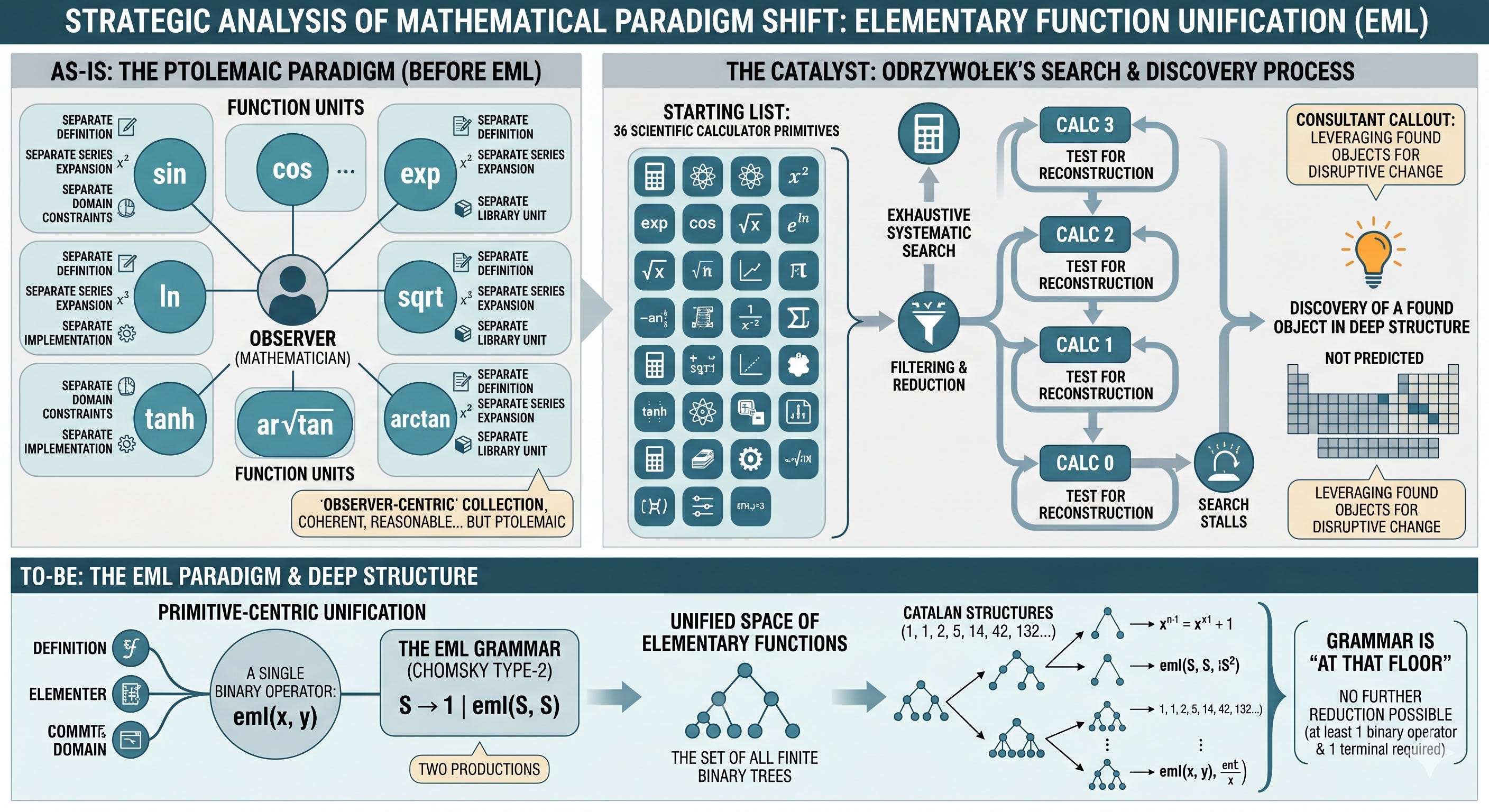
Before EML, the space of elementary functions was organized as a collection of named objects: sin, cos, exp, ln, sqrt, tanh, arctan, and so on. Each one was defined separately. Each one came with its own series expansion, its own domain constraints, its own numerical implementation, its own unit in the standard library of every programming language ever written. The taxonomy was comprehensive, coherent, and completely reasonable. It was also Ptolemaic. It organized the functions around the observer — the mathematician who needed to name and use each one — rather than around a deeper primitive from which they all arise.
What makes Odrzywołek’s approach particularly striking is that he did not construct it from first principles through clever algebra. He found it by exhaustive systematic search — iteratively removing one element at a time from a 36-primitive scientific-calculator starting list, testing at each step whether the remaining set could still reconstruct all the others, working down through configurations he named Calc 3, Calc 2, Calc 1, and Calc 0, until the search stalled at a configuration that strongly suggested a single binary operator might exist. This matters enormously. It means the result was not inevitable from any known theoretical framework — it was discovered, the way Mendeleev discovered gaps in the periodic table before the elements were found to fill them. Nobody predicted it would exist. The search returned it. This is a found object in the deep structure of mathematics.
The grammar of the discovery is itself significant. Every EML expression is described by the context-free production:
S → 1 | eml(S, S)
This is Chomsky Type-2. Two productions. The entire reachable space of elementary function expressions is the set of all finite binary trees over this alphabet — isomorphic to the Catalan structures: 1, 1, 2, 5, 14, 42, 132… The paper notes that no further reduction of operator count is possible: at least one binary operator and at least one terminal symbol are required. The grammar is already at that floor.
The NAND Analogy, Taken Seriously
The comparison that circulates in discussions of this paper — and that the author himself suggests — is to the NAND gate. In Boolean logic, any truth function can be computed from NAND gates alone. This property, called functional completeness, means the entire cathedral of digital logic reduces, at the foundation, to a single two-input gate. Every AND, OR, NOT, XOR, multiplexer, adder, flip-flop, and microprocessor — all of it is NAND gates, composed recursively in the right topology.
The comparison is apt but the EML result is more surprising, because the analog domain is less constrained than the digital one. Boolean functions are mappings between finite sets. The space of elementary functions is infinite and continuous, defined over the complex numbers. The surprise that you can find a single universal primitive here is proportionally larger.
But there is a deeper asymmetry that the NAND analogy obscures. NAND was known and proven relatively quickly after Boolean logic was formalized. The functional completeness theorems are clean and derivable. EML was found by search. This places it in a different epistemological category — not a theorem derived from axioms, but a discovery about the structure of a space that nobody had fully mapped before. It is the difference between proving that a path exists and finding one that nobody knew was there.
The Ternary Iceberg
The paper ends with a sentence that deserves to be read slowly.
The EML operator may be the tip of an iceberg. Preliminary searches have already returned related operators with even stronger properties, including a ternary variant that requires no distinguished constant.
No constant. Not even the number 1. The paper identifies a candidate: T(x, y, z) = eˣ / ln(x) × ln(z) / eʸ, for which T(x, x, x) = 1, and notes it is “next candidate for further analysis.” This is preliminary — the paper does not claim the ternary variant is proven complete. It is a direction, not a result.
What the ternary result would mean, if confirmed, is that the constant 1 — which EML requires to neutralize the logarithmic term and which the paper acknowledges makes EML “less elegant” than the NAND gate — could be eliminated entirely. The EML operator generates 0s and 1s only through composition with its single required constant. NAND generates them from “anything.” A ternary universal primitive with no required constant would close that gap. Whether one exists is described in the paper as an open question.
The Jagiellonian Thread
It is a fact of geography, not argument, that Odrzywołek works at the Jagiellonian University — the institution whose most famous alumnus discovered that the Earth revolves around the Sun by asking which model needed fewer circles. History does not usually arrange itself this neatly. When it does, the appropriate response is to notice it.
The Copernican move, distilled to its principle, is this: when your model is accumulating epicycles, the right response is not to compute the epicycles more precisely. It is to ask whether the coordinate system is wrong. Whether the complexity you are managing is real complexity in the phenomenon, or artificial complexity introduced by your choice of frame.
The field of machine learning has accumulated epicycles of spectacular sophistication. Attention mechanisms, mixture-of-experts routing, RLHF alignment pipelines, chain-of-thought prompting, retrieval-augmented generation, tool use, agent scaffolding — each one an addition to the model that patches something the underlying framework did not naturally produce. Much of this engineering is brilliant. Some of it is necessary. But the accumulation itself is a signal. When a system requires this many auxiliary constructs to produce behavior that ought to be intrinsic, it is worth asking whether the primitives are wrong.
EML does not solve machine learning. It makes a different, more foundational claim: that the mathematical functions underlying intelligence — the computations that any reasoning system must perform to model the world — have a simpler generator than anyone knew. That the taxonomy of elementary functions, which we inherited and extended across centuries, was a Ptolemaic catalog. Organized for the observer. Not for the universe.
The question worth sitting with is not whether EML will replace neural networks. It probably will not, at least not imminently. The question is what it implies about the direction of travel. Every piece of mathematical machinery inside a modern AI system — every activation, every norm, every positional encoding — is an elementary function. All of them, we now know, are special cases of a single recursive composition. The simplest description of all of them together is a uniform binary tree over one operator and one constant.
That is a Copernican fact. It does not tell you what to build next. But it tells you something true about where you are standing, and it suggests that the next coordinate system — the one that makes the epicycles fall away — may not require more complexity. It may require a different center.
The paper: Odrzywołek, A. (2026). “All elementary functions from a single binary operator.” arXiv:2603.21852.
Alan Eyzaguirre writes about AI systems, generative media, and the long view on intelligence at Ace8.substack.com.